Our complete agency deck — strategy, systems, and case studies.
Browse the full presentation below or open in Google Slides ↗
We don't optimise bids. We rebuild the signal architecture so Meta's algorithm works for your profit.
Campaigns are tactical. Systems are strategic. Every engagement starts with a complete efficiency audit — identify every material leak, prescribe the precise fixes, and install autonomous protection so efficiency compounds daily.
We are not here to scale spend. We are here to make every rupee work harder. The single objective of a tnt. Meta engagement is clear:
In almost every fintech and lending account we audit, three interconnected constraints limit efficiency. They appear in different intensities, but the pattern is consistent.
_valueToSum and currency. The algorithm can only optimise for the occurrence of a conversion, not its value or quality. Meta’s own data associates proper value optimisation with ~9.8% better ROAS.We never start with creative or bid changes. We start with the highest-leverage structural failures.
| Issue | Evidence Source | Severity |
|---|---|---|
| Disbursal Value + Currency Missing | Events Manager → Diagnostics | Critical |
| Frequency 4.0+ | Campaign export (30 days) | Critical |
| Advantage+ Placements Off | Campaign settings | High |
| Creative Sameness / Fatigue | Ads export + creative review | High |
| Advanced Matching Fully Off | Events Manager → Settings | High |
| No Conversions API | Integrations tab | High |
| High-CPA ads still active | Ads level export | Medium |
Most accounts rely solely on MMP + SDK. That creates three silent failures: missing value parameters, empty Advanced Matching, and zero server-side backup.
Current (Typical)
Ideal (tnt. Standard)
Way Forward — Three Sequential Steps
Expected: Better data quality → Algorithm learns faster → Lower Cost per Loan + more stable performance.
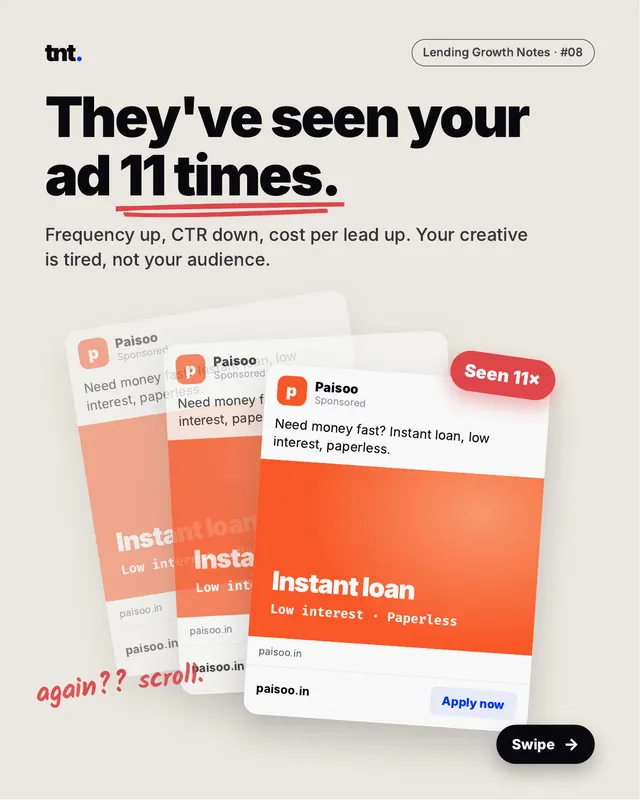
Frequency 4.36 is already in the danger zone. Top ads cross 3.5 while the same hooks (“Quick cash”, “Instant loan”, “Zero paperwork”) appear across the set. Quality rankings drop into Bottom 35%.
Way Forward: Set frequency alerts at 3.5 and hard pauses at 4.2. Rotate creative before CTR collapses.
When Advantage+ Placements is Off, budget is locked into whatever the human selected. Real data usually shows In-stream and certain Feed placements outperform the heavy Reels allocation.
Default action: Turn Advantage+ Placements On unless there is a documented, data-backed reason not to.
Rules run at Ad level, evaluated every 30–60 minutes, lookback last 3 days. They turn human lag into machine speed.
Platform defaults hide the truth. We build an “Efficiency View” with custom metrics that force honest ranking:
The outcome
Cleaner signals → algorithm learns real value → lower Cost per Disbursal → more stable performance. Every day compounds because the system, not a junior account manager, is protecting efficiency 24/7.
This is not a performance report. This is a structural efficiency audit.
We isolate every systemic inefficiency that inflates true Cost per Disbursal, quantify the opportunity cost of the current architecture, then install autonomous scripts that protect the corrected system 24/7.
Smart Bidding does not understand “business value”. It understands the conversion actions you mark as Primary and their relative volume.
What the algorithm is actually optimising for
Current Primary focus is concentrated on the third step. The business cares about the fifth.
Google’s own guidance: “Target one in-app action” for tCPA campaigns. Choose the action that represents real value, not the most frequent one.
Brand Search is the cleanest traffic in the entire account and is almost always severely under-funded. This is pure opportunity.
| Segment | Typical CPA | CVR |
|---|---|---|
| Brand Exact (“pocketly loan”) | ₹9–11 | 34–36% |
| Total Search | ~₹13 | ~20% |
| Broad / Generic leakage | Higher + wasted | Low / zero |
Action: Protect Brand impression share. Never let budget caps quietly suppress the highest-intent queries.
Once the structure is corrected, we install rules and scripts so efficiency cannot silently erode.
Core Automation Rules
Supporting Scripts
Clean Primary signal focused on Disbursal → algorithm stops chasing cheap opens → Brand Search receives the capital it deserves → broad-match leakage is continuously harvested → true Cost per Disbursal becomes visible and controllable.
Every day compounds because the system, not a human checking a dashboard twice a week, is protecting structural efficiency.
We don't bill for clicks or impressions. We bill for outcomes.
Our affiliate model aligns 100% with your business goals — we only get paid when a verified business outcome occurs. Zero risk, full alignment.
Current Fintech Partners
Ring
PocketlyDriving high-volume, high-quality acquisitions for leading fintech brands.
Why this works
We don't just run campaigns. We build proprietary systems that give our clients an unfair advantage.
Every system is designed to increase efficiency, reduce waste, and make every rupee work harder.
The Result
Every system works together to create a closed loop of intelligence, execution, and optimization. This is how we consistently outperform traditional agencies by 3–5×.
G2 verification is the gatekeeper to your ad spend. We ensure you pass it — fast.
Failed verification means frozen campaigns and lost revenue. We manage the entire Google 2-step verification process end-to-end.
The tnt. G2 Process
We review all your business documents — PAN, GST, address proof, bank statements — and flag gaps before you submit. 100% document readiness.
We act as your direct point of contact with Google's verification team, ensuring fast responses, clear communication, and no back-and-forth delays.
For fintech, lending, and regulated brands, we ensure your Google Ads account meets all regulatory requirements — no compliance surprises.
We streamline the verification process, reducing approval time to 7–10 days. Post-approval, we monitor your account to ensure ongoing compliance.
Verification Flow
Google Ads Account — Verified
All G2 verification requirements satisfied
Same audience. Same auction. A second bid you never meant to place.
CPMs rise for no reason. No CAC ceiling in sight.
Overlap removed. Stop bidding against yourself.
Brand, prospecting, retargeting — each with one job.
If it can’t pay back, it doesn’t spend.
From marketplace CAC spiral to the first profitable months in half a year. Foundation before scale. Sequence over speed.
Naturavest sells pure wellness — Himalayan Sea Buckthorn, Glutathione, Marine Collagen. Early Amazon/Flipkart ads looked fine at 2–3× ROAS.
Then spends jumped. CAC climbed. Orders stayed flat. Six–seven months of pouring money while efficiency disappeared.
The brief was scale. The reality was: no clear brand, no converting website, no GTM, no funnel — just marketplace ads carrying an entire company.
Marketplace ads capture demand. They don’t build preference. When CAC rises, bid/keyword levers stop working. You need a brand people choose — and a system that turns choice into profit.
Four phases. Nothing moved forward until the previous phase had done its job.
The drop is normal. The useful number is the ROAS you can still hold while growing absolute contribution.
Google found people who already cared about purity and science. The website educated and converted. Meta closed the ones who had already visited.
Demand + education. High-intent search as the primary engine.
Proof + conversion. The machine marketplace ads never built.
Close warmed traffic. ₹3.5L in → ~₹9L out.
Don’t copy the channels. Copy the refusal to scale a broken system. Fix the machine first. Then turn the volume up.
A complete diagnostic and system-building engagement across creative performance, content calendar, Meta lead + awareness architecture, and Google Ads hygiene — designed for a high-consideration, policy-sensitive category.
Archish operates in one of the most emotionally charged and regulated advertising categories in India — IVF and Egg Freezing. The account showed classic symptoms of creative and structural drift:
This was not a “run more ads” engagement. It was a full systems layer across creative, content, paid media and measurement.
Male fertility creatives consistently delivered lower cost-per-result (Men’s Ball ₹7.07, Men’s Size ₹11.17, Men’s Ice-cream ₹10.29). Female-targeted assets showed higher engagement in some cases but significantly higher costs and saturation risk. Clear recommendation: expand male fertility creative testing while protecting female efficiency with stronger lifestyle and empowerment angles.
Campaigns were organised by intent and format: Xpert & LAL Instant Form for high-intent leads, ADV+ for broader efficiency, dedicated Egg Freezing Awareness + Consideration, video views for top-of-funnel, and C2WA messaging. Always-on IVF statics, videos and testimonial carousels ran underneath campaign spikes (Egg Freezing Month).
A full-month organic + paid calendar was built to support the performance layer:
This ensured paid media was never running in isolation — organic and paid reinforced the same narrative of agency, education and carefully framed hope.
October & November data further confirmed: ThruPlay awareness can be run efficiently at low cost-per-result, while lead campaigns require tight creative + audience discipline to keep CPL in a sustainable range for a fertility brand.
We did not just optimise bids. We diagnosed creative reality, built the content and media architecture around it, and left a clear operating system so the brand can continue without constant reinvention.
From a leaking, unstructured lending account to a profit engine: cost per conversion ₹3,700+ → ₹300–400. Disbursals 25 Cr → 108 Cr. Meta revived as a volume channel.
FatakPay is consumer lending. The mandate was not “more leads.” It was add ₹50 Cr disbursals every month — while staying profitable.
Spend without a machine is how lending accounts die. Tracking was incomplete. Accounts were unstructured. App errors leaked conversions. CAC was climbing. Nobody could benchmark a good week from a bad one.
Lending is unforgiving. If the platform cannot see a disbursal, it optimises for a cheap lead. If campaigns fight each other, CPMs inflate. If the app breaks, every rupee after that is waste.
Four phases. Nothing scaled until the previous phase had earned the next rupee.
Spend went up. CAC went down. That only happens when the leaks are closed.
The funnel was the real product. Ads only look expensive when the middle is leaking.
Do not buy more disbursals from a leaking account. Fix the signal. Funnelise the structure. Then turn the volume up. That is how 25 Cr becomes 108 Cr without CAC eating the P&L.
A full launch-and-scale: media 5×, CPI halved, installs 3×, repayments 14×, conversion 5×. The acquisition engine was built — not rented.
Zavo needed a brand in market and an engine that could acquire, convert, and collect. There was no existing structure to inherit.
Later is how fintech accounts lose the first six months. Tracking gaps. App errors. No funnel. No benchmarking. Creative with nowhere to land.
A launch is not a campaign. It is a sequence: signal, structure, creative, then spend. Skip the first two and every rupee teaches the platforms the wrong user.
Same discipline as a turnaround — except we never had a broken machine to unlearn. We refused to skip the sequence anyway.
Spend 5× is only impressive if unit economics improved with it. They did.
Daily repayments moved ₹6Cr → ₹16Cr+ in parallel. The book thickened because acquisition finally had a system underneath it.
Installs are a vanity line until repayment is the event. We wired the stack so the algorithm trained on money, not downloads.
Acquire the right user. Credit management — not “download now.”
KYC and repayment errors treated as CAC. Product sits inside media.
The only training signal. Book went 14×. Daily ₹6Cr → ₹16Cr+.
Do not “go live and tidy later.” Build the signal, the funnel, and the kill rules first. Then the 5× spend is a decision — not a hope. That is how ₹7L becomes ₹3.6 Cr.
57× ROAS on ₹62K. Monthly revenue ₹12L → ₹35L+. Proof that small brands scale with precision, not pressure.
A hyper-local D2C brand. Real demand in a handful of pincodes. National-looking ads. A revenue plateau that no viral spike could break.
Viral is not a system. ₹10–12L months with flukes on top is a business waiting for the next accident. There was no lean funnel. No pincode-level message. No pruning.
Hyper-local is a constraint, not a handicap. The advantage is knowing exactly where a rupee is allowed to work. Most agencies throw that away with broad targeting and generic hooks.
Creative spoke to everyone. Spend leaked into pincodes that never buy.
Buyers lived in a handful of pincodes. The map was the targeting.
We did not scale budget to escape the plateau. We made every rupee geographically honest.
The point was not a hero ROAS screenshot. It was that a small brand does not need a big budget once the map is true.
A small team cannot afford a weekly autopsy. Decisions had to be real-time or they were already late.
Spend allowed. Everywhere else, illegal.
Message matches the street. The page closes the click.
Copies, spends, leaks. Kill fast. Feed winners.
You do not need a bigger media plan. You need a tighter map. Speak to the pincodes that already buy. Close them on a page built for that click. Prune everything else. That is how ₹12L becomes ₹35L without a war chest.